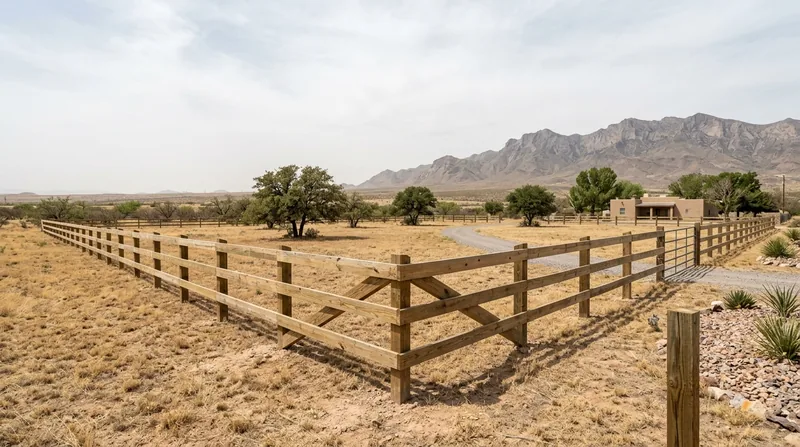




The Lower Valley and rural reaches of Greater El Paso, from San Elizario and Clint to Fabens and beyond, depend on farm fence installation to manage livestock, define property lines, and protect irrigation-fed pecan and cotton operations across open acreage. Where residential El Paso stops, ranch land takes over, and the fencing demands shift from privacy and aesthetics to durability, livestock containment, and the ability to span long runs over uneven terrain. El Paso Fence Company has installed ranch rail, no-climb horse fence, field wire and pipe fencing across Greater El Paso since 2015, working straight lines over long distances, bracing corners against wind and livestock pressure, and sizing gates for trailers and equipment. The high-desert climate, intense sun, wind-scoured gravel foothills, and seasonal dust storms that sweep across the valley floor demand materials and installation methods that hold up to years of exposure and hard use. We work from your property line, handle all utility locates, and build fencing that works.
Why Farm and Ranch Fencing Matters in El Paso's Rural Communities
Acreage in the Lower Valley and outlying areas of El Paso County requires fencing that does more than look good. Livestock fencing must contain animals reliably, withstand repeated pressure from horses and cattle, and survive the intense UV exposure and wind-driven dust of the Chihuahuan Desert. Property lines on multi-acre parcels need clear, durable demarcation that lasts decades without constant repair. Field fencing and perimeter fencing on working land protects equipment, secures irrigation infrastructure, and defines boundaries in areas where neighbors may be separated by significant distance.
- Livestock containment fencing must withstand repeated animal pressure, sharp hooves, and the wear of daily contact over years of service.
- Long-run fencing across acreage requires proper post spacing, braced corners, and anti-sag bracing to stay straight and functional in high-desert wind.
- Pipe and rail fencing on working ranches handles equipment movement, trailer access, and the seasonal stress of ranch operations.
- Proper utility locates before digging post holes protect buried water lines, electrical conduit, and irrigation infrastructure common to Lower Valley properties.
- Gates sized for trailers, tractors and equipment require sturdy frames, self-closing hardware, and proper hinge support to operate reliably year after year.
The stakes are real: a failed fence line means loose livestock, property disputes, or damaged equipment. We build it to work.
Key info: Texas law requires a free utility locate call to 811 before any post hole is dug. We handle this step to protect buried water, electrical and irrigation lines common across Lower Valley acreage in San Elizario, Clint, Fabens and surrounding ranch country.
For more on our full range of fencing services, visit our homepage or explore fence repair options if you have existing fencing that needs attention.
How We Install Farm and Ranch Fencing Across El Paso Acreage
Farm and ranch fencing on open land requires a methodical approach: we establish your property line, call for utility locates, set posts at proper spacing with concrete or tamped earth depending on soil conditions, and install rails, wire or pipe with bracing at corners to resist the wind and animal pressure that dominates in the high desert. Straight lines over long distances demand skill and the right equipment. We measure twice, set posts plumb, and build gates that swing freely and latch reliably.
- We verify your property line and identify any deed restrictions or county setback rules that apply to your acreage.
- We call 811 for a free utility locate to mark buried water, electrical and irrigation lines before post holes are dug.
- We set posts at proper spacing (typically 6 to 8 feet for ranch rail, 4 to 6 feet for horse fence) in concrete or tamped earth depending on soil type and frost depth.
- We install rails, wire or pipe with anti-sag bracing at corners and long runs to maintain straight lines under wind and animal pressure.
- We hang and adjust gates with self-closing, self-latching hardware sized for trailers and equipment access.
- We walk the entire line with you to confirm the work meets your needs.
The result is fencing that holds livestock, defines property, and lasts. We also offer gate installation and repair for any agricultural or ranch operation.
Example: A 10-acre parcel in Clint with split rail fencing around the perimeter (roughly 1,300 linear feet) typically runs 4 to 6 weeks from estimate to completion, depending on weather, post-hole depth in caliche, and gate count. We coordinate the work to minimize disruption to your ranch operations.
Farm and Ranch Fencing Methods and Materials
| Approach | Description | Best for |
|---|---|---|
| Split Rail Fencing | Wood rails mortised into posts, typically 2 or 3 rails high, spaced 6 to 8 feet apart for long runs. | Property definition, horse pastures, and traditional ranch aesthetics across open acreage. |
| No-Climb Horse Fence | Welded wire mesh mounted to posts, typically 4 to 5 feet high, with smaller openings to prevent hooves from catching. | Horse containment, livestock security, and protection against escape or injury on working ranches. |
| Pipe and Post Fencing | Steel pipe or galvanized tubing set in concrete posts, typically 1.5 to 2.5 inches diameter, spaced 4 to 6 feet apart. | Extreme durability, cattle operations, equipment containment, and high-impact environments. |
| Field Wire and Barbed Wire Fencing | Tensioned wire strung between posts with stretcher bars and tension bands, typically 4 to 6 strands for cattle. | Large perimeters, cost-effective livestock containment, and working ranches where traditional wire is standard. |
Each method is chosen based on your animal type, acreage size, terrain, and long-term maintenance expectations. We recommend the material that delivers the best value over the life of the fence.
Farm and Ranch Fencing Cost in El Paso: What to Expect
Farm and ranch fencing cost in Greater El Paso starts at approximately $12 per linear foot for basic split rail or field wire on open acreage, and ranges upward to $18 to $25 per linear foot for no-climb horse fence, pipe fencing, or installations that require significant grading, caliche removal, or extended gate work. A 1,000-foot perimeter on an acreage parcel in the Lower Valley might run $12,000 to $25,000 depending on material choice, terrain, post spacing, and gate count. Factors that move the price include depth to solid ground (caliche is common in El Paso and requires extra labor), distance from our shop (travel is included in Greater El Paso), number and size of gates, and whether existing fencing needs removal.
We recommend getting two or three estimates from local contractors who understand El Paso terrain and ranch operations. Visit our pricing overview for detailed breakdowns by material and job type, and call us at (915) 621-2956 for a free, no-obligation estimate. We respond within 24 hours and provide a written proposal before any work begins.
What to Look for When Hiring a Farm and Ranch Fencing Contractor Near Me in El Paso
Choosing the right contractor for acreage fencing means verifying insurance, understanding how permits work in your jurisdiction, checking references on similar ranch projects, and confirming that the crew understands El Paso terrain and livestock containment. In Texas, fence installation does not require a state contractor license, but projects above a certain dollar threshold may require a licensed general contractor; your local county building department will clarify the threshold and rules for your specific acreage. Always ask for proof of general liability and workers' compensation insurance, and request a certificate of insurance for your records. We are fully insured and provide a certificate on request.
- Verify that the contractor carries general liability and workers' compensation insurance and can provide a current certificate.
- Check references from ranch and acreage projects in El Paso, Horizon City, Socorro, San Elizario or Clint to confirm experience with livestock fencing and long-run installations.
- Confirm that the contractor understands local terrain, caliche depth, and wind bracing requirements specific to the high desert.
- Ask about permit requirements for your specific county or jurisdiction; rules vary across El Paso County, and your county building department has the final say.
- Request a written estimate that breaks down material, labor, and any site-specific costs before you commit.
- Verify that utility locates (811 calls) are included in the scope and will be completed before post holes are dug.
We are an AFA Member Installer with the American Fence Association, have been in business since 2015, and work exclusively in Greater El Paso. Call us at (915) 621-2956 or visit our contact page to schedule a free estimate on your acreage fencing project.
Farm & Ranch Fencing in El Paso: Pricing Guide
| Service | Price | Details |
|---|---|---|
| Split Rail Fencing | Starting at $12/ft | Wood rails mortised into posts, 2 to 3 rails high, includes posts set in concrete and post spacing 6 to 8 feet |
| No-Climb Horse Fence | Starting at $16/ft | Welded wire mesh 4 to 5 feet high, livestock containment, includes posts in concrete and proper tension setup |
| Pipe and Post Fencing | Starting at $18/ft | Steel or galvanized pipe 1.5 to 2.5 inches, extreme durability for cattle and equipment, posts spaced 4 to 6 feet |
| Field Wire and Barbed Wire Fencing | Starting at $10/ft | Tensioned wire strands between posts, cost-effective livestock containment, includes stretcher bars and tension bands |
| Gates and Hardware | $400 to $1,200 each | Self-closing, self-latching hardware, sized for trailers and equipment, includes installation and adjustment |
| Free Estimate | No obligation | Response within 24 hours at (915) 621-2956, includes site visit, utility locate coordination, and written proposal |
Indicative pricing, the exact cost depends on square footage, finish, and site access. Free personalized estimate within 24h at (915) 621-2956.


