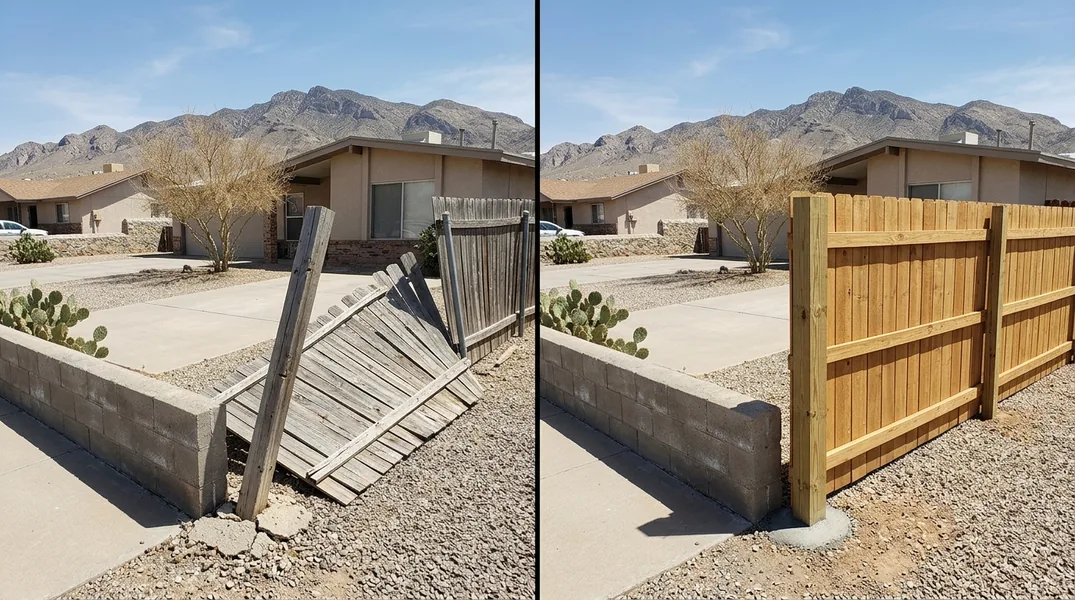
Why El Paso Fences Lean: The Desert Climate Factor
If you own a home in El Paso, you've probably noticed fences that tilt, sag, or lean at awkward angles. It's not just poor installation, though that's sometimes part of the problem. The real culprit is El Paso's intense desert climate combined with challenging soil conditions. Our region experiences extreme temperature swings, intense UV exposure, and very low humidity levels that create a perfect storm for fence damage.
The sun in El Paso is relentless. Summer temperatures regularly exceed 95 degrees Fahrenheit, and the sun's rays beat down on fence posts day after day without mercy. Wood absorbs this heat and expands, then cools at night and contracts. Over months and years, this constant expansion and contraction cycle causes the wood fibers to weaken, crack, and split. The wood doesn't just age gracefully; it becomes brittle and loses its structural integrity. When a fence post weakens this way, it can no longer support the weight of the fence panels, and the entire structure begins to lean.
Sun-Cracked Footings: How Heat Destroys Concrete Below Ground
Most people think concrete footings are permanent and unchanging, but that's a misconception. When a fence post is set in a concrete footing, the concrete absorbs and radiates heat just like the wood does. The surface of the footing heats up dramatically during the day, while deeper layers stay cooler. This creates internal stress within the concrete itself. Over time, tiny cracks form and expand. Water seeps into these cracks, freezes during the rare cold snaps we get in winter, and pushes the cracks wider. This cycle of thermal stress and moisture infiltration gradually weakens the footing from the inside out.
As the concrete footing deteriorates, it loses its grip on the fence post. The post, which should be held firmly in place, begins to shift and settle unevenly. Soil erosion around the base of the post accelerates the problem. Rain, even our infrequent desert rains, can wash soil away from the footing, creating voids underneath. Once a void forms, the post has nothing supporting it in that spot, and it tips toward the weakest point. This is why you see leaning fences in El Paso so frequently. The damage starts underground, where homeowners can't see it until the fence is already leaning noticeably.
Caliche Soil: El Paso's Hidden Fence Enemy
El Paso's soil composition is unique and challenging for fence installation. Much of our region sits on or near caliche, a hard, calcium carbonate-rich layer that forms naturally in desert environments. Caliche is essentially rock-hard soil that's difficult to dig through and doesn't drain water well. When fence posts are installed in caliche, water pools around the base instead of draining away. This standing water accelerates concrete deterioration and creates an environment where the wood post absorbs moisture and begins to rot.
Additionally, caliche is unstable for footings because it doesn't compact evenly. Some areas of the caliche layer are softer than others, creating uneven support. A fence post set in caliche may be rock-solid on one side and slightly loose on the other. As the post settles over time, it settles unevenly, causing stress on the footing and the post itself. The post begins to cant or lean as it seeks the path of least resistance. Professional fence installers in El Paso know how to work with caliche by drilling through it properly, improving drainage, and using deeper footings that anchor below the problematic layer. This is why choosing an experienced local contractor matters so much.
Recognizing the Signs: When Your Fence Needs Repair
A leaning fence doesn't happen overnight. There are usually warning signs that appear weeks or months before the problem becomes obvious. The first sign is often small cracks in the wood posts, especially on the side facing the sun. These cracks start small but grow wider as the wood continues to expand and contract. You might also notice that fence panels don't hang quite right anymore, or that there are gaps between panels and posts where there weren't any before. The fence gate might stick or swing unevenly, which is a strong indicator that the posts supporting it have shifted.
Another key warning sign is visible movement in the concrete footing. If you can see cracks radiating out from the base of a post, or if the concrete appears to be heaving or settling unevenly, that's a red flag. Sometimes you'll notice soil erosion around the base of posts, or small voids where the footing has pulled away from the surrounding soil. Don't wait until the fence is leaning at a 10-degree angle to call for help. Early intervention with fence post repair or fence post replacement is always less expensive and more effective than waiting for catastrophic failure.
The Right Fix: Leaning Fence Repair and Post Replacement Solutions
If your fence is already leaning, you have several repair options depending on the severity of the problem. For minor leans where the post itself is still structurally sound, a fence post repair might involve reinforcing the footing with additional concrete or installing steel braces to stabilize the post. This approach works best when the damage is caught early. However, if the post is cracked, rotted, or severely weakened, fence post replacement is the better solution. A new post installed with proper technique will serve you reliably for years to come.
For cracked fence footing repair, the solution depends on how severe the cracks are. Small surface cracks can sometimes be sealed and reinforced. Larger structural cracks or severely deteriorated footings require removal and replacement. This is where professional expertise becomes invaluable. El Paso Fence Company has installed and repaired hundreds of fences in our region and understands exactly how to address these issues. We use deeper footings than standard, improve drainage around posts, and choose materials that withstand our harsh desert climate. When you're ready to fix your leaning fence, call us at (915) 621-2956 to discuss your specific situation and get a free estimate.
Prevention: How to Protect Your Fence from Future Damage
The best fence is one that never develops problems in the first place. If you're planning new Wood & Privacy Fence Installation, make sure your contractor uses proper techniques designed for El Paso's climate. This means deeper footings than the standard 24 to 30 inches, better drainage around the base of posts, and quality materials that can handle our UV exposure and temperature extremes. Consider applying a UV-protective sealant to wood posts annually. This simple maintenance step can extend the life of your fence by years.
Proper drainage is critical. Make sure water doesn't pool around the base of fence posts. If you notice standing water after rain, improve the grading or add drainage solutions. Trim back vegetation that touches fence posts, as constant moisture from plants accelerates rot. Inspect your fence at least twice a year, looking for the early warning signs we discussed. Catching problems early is always cheaper and easier than dealing with a fence that's already leaning. When you need professional help with fence repair or want to ensure your new fence is built to last, El Paso Fence Company is here to help. Contact us at (915) 621-2956 or visit our website for a free estimate today.
Looking for a professional fence contractor in El Paso? El Paso Fence Company responds fast for all your fence needs.
Get a Free Quote